 Fraunhofer Institute for Computer Graphics Research IGD
3D Point Clouds in Cereal Breeding: Efficient Field Data Collection
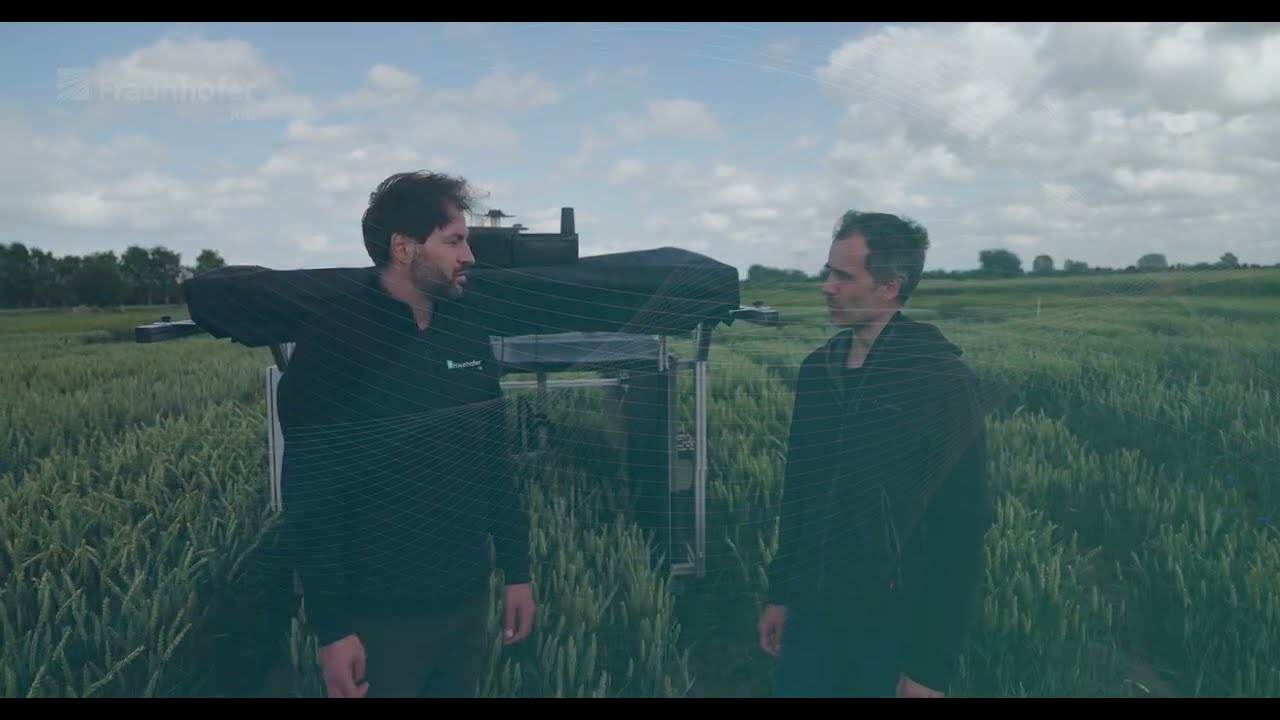
Phenotyping refers to the determination of plant characteristics and is particularly important in cereal breeding. However, manual data collection is highly time-consuming and difficult to scale to large areas. With its 3D point cloud approach, Fraunhofer IGD is developing an automated solution that enables plant structures to be analysed directly in the field.
The aim of the “Point Clouds in Breeding” project is to develop a camera system optimised for capturing 3D scans (point clouds) under field conditions, as well as an AI pipeline capable of analysing point cloud data quickly and reliably. This provides an important foundation for modern high-throughput phenotyping.
The solution is aimed at experts in research, plant breeding and agricultural technology. If you are interested in collaborating or have questions about specific use cases, our expert Sarah Hoppe will be happy to assist you.
Challenges of Data Collection in Cereal Breeding
Changing lighting conditions, different growth stages and natural variations between cereal ears make standardised data collection difficult. At the same time, there is a growing need to efficiently analyse large areas of cereal crops.
Existing approaches have their limitations: manual methods are time-consuming and subjective, while 2D imaging techniques often struggle to reliably distinguish overlapping plants. Particularly in dense crop stands, it can be difficult to clearly identify individual ears.
This poses a major challenge for plant breeders, research institutions, fertiliser manufacturers and companies involved in field trials. Fraunhofer IGD’s use of 3D point clouds enables the automated analysis of plant structures and provides the basis for scalable phenotyping.
3D Point Clouds in Cereal Breeding

Tabbed contents
2D Segmentation and 3D Clustering
Cereal ears are automatically detected and segmented in the 2D image data. The 3D model is then reconstructed, using the 2D information to focus specifically on the ears.
In the next step, a clustering method assigns the individual points to specific ears. This makes it possible to determine the number of ears. Even under real field conditions, the method delivers stable and precise results.
2D Segmentation Combined with 3D Deep Learning
Similar to the first strategy, cereal ears are automatically detected in 2D image data and the results are transferred to the 3D point cloud. However, instead of using clustering to separate individual ears, this approach applies a 3D deep learning model (OneFormer3D). In this way, the method contributes to research into deep learning approaches for point cloud processing.
Advantages of 3D Point Clouds in Cereal Breeding
The combination of 2D segmentation and 3D processing enables reliable detection and counting of individual cereal ears. The camera system developed as part of the project has also proven robust under field conditions in practical tests. By combining the hardware with the processing pipeline, reproducible metrics can be generated efficiently.
3D point clouds therefore represent a key building block of digital phenotyping. The approach can also be transferred to other plant parts and crop types.
Are you interested in further information or collaboration? We look forward to hearing from you.

AI in Wheat Fields: 3D Point Clouds for Cereal Breeding
Privacy warning
With the click on the play button an external video from www.youtube.com is loaded and started. Your data is possible transferred and stored to third party. Do not start the video if you disagree. Find more about the youtube privacy statement under the following link: https://policies.google.com/privacyWhat are the advantages of combining 2D segmentation and 3D clustering?
The combination of 2D segmentation and 3D clustering enables precise detection and counting of individual cereal ears, even under real field conditions. Compared with approaches based solely on 3D data, this method is significantly more accurate. The reason is that image information and spatial data are deliberately combined, allowing them to complement each other effectively.
How does the analysis of cereal ears using 3D point clouds work in practice?
Image data captured directly in the field is processed into 3D point clouds and analysed automatically. This makes it possible to analyse even large experimental plots efficiently, objectively, and reproducibly.
What specific advantages does automated cereal ear analysis offer?
Automated cereal ear analysis reduces the effort required for data collection while providing precise and reproducible metrics. This creates a reliable data basis for improving breeding decisions and making workflows in plant research more efficient.
Why are 3D point clouds important for digital phenotyping?
3D point clouds are a key component of digital phenotyping because they capture plant structures in a realistic and detailed way. Combined with AI-based methods, they enable scalable, data-driven analysis that can be used reliably under real-world conditions.
Who benefits most from the use of 3D point clouds in cereal breeding?
The technology is particularly relevant for plant breeders, research institutions, and companies working in digital agriculture. It can be used wherever large volumes of data need to be analysed efficiently and objective plant traits need to be recorded reliably.
How can I use 3D point clouds in my own project?
The technology can be seamlessly integrated into existing processes, from image acquisition and 3D reconstruction to automated analysis. Depending on the specific use case, it can be adapted flexibly.
How can I get in touch or start a collaboration with Fraunhofer IGD?
For further information or enquiries about potential collaborations, our expert Sarah Hoppe will be happy to assist you.